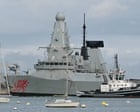
Far-Right Activists Protest Asylum Seekers Arrival in Portsmouth

Major Protest Response to Maritime Interception
A significant gathering of far-right activists converged on Portsmouth following the interception of a vessel carrying approximately 140 asylum seekers attempting to reach the English coastline. The unprecedented deployment of maritime resources, including helicopter units, fixed-wing aircraft, and multiple lifeboats, underscores the scale of the operation conducted by authorities. The far-right protesters assembled in response to news of the arrival, marking a notable escalation in organized opposition to asylum seeker processing at UK ports.
The interception represents a watershed moment for Portsmouth, as this marks the inaugural instance of such a substantial vessel containing migrants being directed to the maritime city's shores. Equally significant is the organized nature of the far-right protesters' response, demonstrating an unprecedented coordination among anti-immigration activists to obstruct the transfer of newly arrived individuals through the port authority's established procedures.
Influencer-Led Coordination and Livestream Mobilization
Digital platforms played a crucial role in galvanizing the far-right protesters, as social media influencers actively livestreamed calls encouraging participants to congregate at Portsmouth. These influencers explicitly urged men to travel to the port with the stated objective of physically blocking coaches designated to transport the asylum seekers away from the location. The use of real-time broadcasting to mobilize far-right protesters represents an evolving tactic in contemporary protest movements, leveraging social media's reach to coordinate large-scale gatherings rapidly.
The influencer-led approach to mobilizing far-right protesters demonstrates how digital communication channels have transformed protest organization. Rather than relying solely on traditional notification methods, activists utilized livestreaming to generate immediate engagement and encourage real-time participation in blocking operations at Portsmouth's coach departure points.
Processing Procedures and Government Response
The Home Office has established protocols for managing newly arrived asylum seekers brought to shore at Portsmouth. The standard procedure involves transferring individuals from the maritime port to Manston, a processing facility located in the vicinity of Ramsgate, Kent. This facility serves as the primary distribution and assessment center for small boat arrivals throughout the region, where initial intake procedures and documentation processes occur.
The presence of far-right protesters at Portsmouth created logistical challenges for authorities tasked with executing these established procedures. The organized nature of the far-right protesters' efforts to obstruct coach movements represented an unprecedented challenge to the orderly processing of asylum seekers at this particular port location.
Historical Context of Port Operations
Portsmouth's experience with large-scale asylum seeker arrivals via small boat had been limited prior to this incident. The convergence of both the maritime interception and the far-right protesters' organized response simultaneously positioned Portsmouth at the center of contemporary immigration debates. The historical significance lies not merely in the volume of individuals aboard the intercepted vessel, but in the coordinated resistance mounted by far-right protesters against their processing and transfer.
The unprecedented gathering of far-right protesters at Portsmouth signals a potential shift in how organized opposition to asylum seeker arrivals manifests geographically across UK coastal regions. Previously, such demonstrations had not been orchestrated at Portsmouth with comparable scale or coordination, making this episode a notable departure from historical patterns.
Broader Implications for Port Security and Public Order
The incident raises questions regarding port security protocols and the management of public demonstrations during sensitive operations involving vulnerable populations. Authorities must balance the operational requirements of transferring asylum seekers while maintaining public order amid organized far-right protesters' presence. The coordination demonstrated by far-right protesters suggests that similar incidents may occur at alternative port locations receiving asylum seekers.
The far-right protesters' attempt to physically obstruct coach movements represents a direct challenge to government immigration enforcement capabilities. The response from law enforcement and relevant agencies in managing the convergence of far-right protesters at Portsmouth will likely inform protocols for future incidents involving asylum seeker arrivals and potential opposition from organized activist groups across multiple UK ports and coastal areas.